
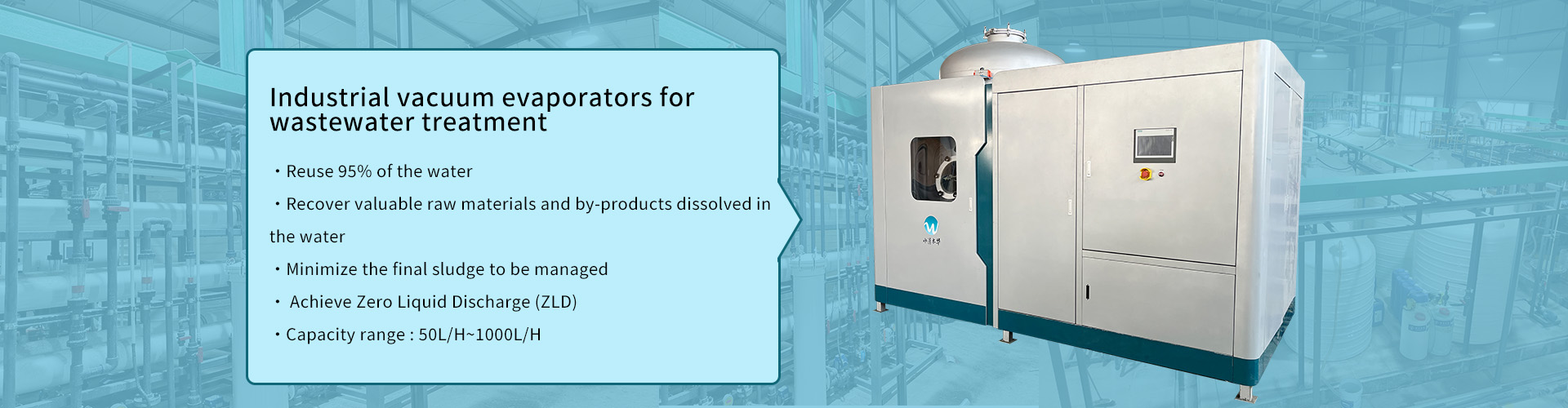
Low-Temperature Vacuum Evaporation
Reduce Industrial Wastewater Volume and Recover Distillate
Heat-pump vacuum evaporators engineered for wastewater minimization, process-liquid concentration and water recovery at approximately 35°C.
When Is a Vacuum Evaporator a Good Fit?
Reduce liquid volume before off-site hazardous-waste management.
Concentrate streams that cannot be further treated economically by membranes alone.
Recover distillate for reuse or further treatment and concentrate valuable process materials where feasible.

How It Works
A vacuum lowers the boiling point of water. The closed heat-pump system uses a refrigerant circuit to provide heat to the evaporation chamber and cooling to the condenser. Wastewater boils at approximately 35°C, water vapour is condensed, and the remaining liquid becomes progressively more concentrated.
The low operating temperature can be beneficial for heat-sensitive liquids and reduces the need for an external steam source. Actual evaporation rate, energy use, concentration factor and distillate quality depend on feed composition and operating conditions.
Typical Applications
- Cutting fluids, coolants and oily emulsions
- Electroplating and metal-finishing wastewater
- Electroless nickel wastewater
- RO reject and demineralizer regeneration streams
- Tank, reactor and floor-washing wastewater
- Chemical and pharmaceutical process liquids
- High-salinity wastewater and brines
- Food, biotechnology and heat-sensitive concentration
Engineering Features
- Low-temperature operation: typically around 35°C under vacuum.
- Electric heat-pump system: no external steam required for standard configurations.
- Automatic control: PLC-based operation with configurable remote monitoring.
- Materials selected for the feed: stainless steel or corrosion-resistant options based on laboratory analysis.
- Customized capacity and process: designed around daily volume, operating hours and target concentration.
- Integrated options: pretreatment, foam control, concentrate management, polishing and crystallization.
Performance Must Be Verified for Your Wastewater
Volume reduction of 90% or more may be achievable for suitable feeds, but the result is limited by salt solubility, viscosity, boiling-point elevation, scaling, foaming and organic volatility. Distillate may be suitable for reuse or further treatment only after confirming the required quality. COD separation depends strongly on the type and volatility of organics present.
For complex or variable wastewater, GRELLIX recommends water analysis followed by bench or pilot testing before final equipment selection.
Information Needed for Preliminary Selection
Wastewater source and analysis • daily capacity • operating hours • current disposal method • target concentrate condition • required distillate quality • available utilities.
Equipment Gallery
-
- Vacuum Evaporator
-
- Vacuum Evaporator
-
- Vacuum Evaporator
-
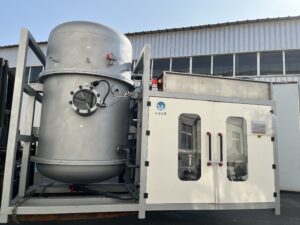
- Vacuum Evaporator
-
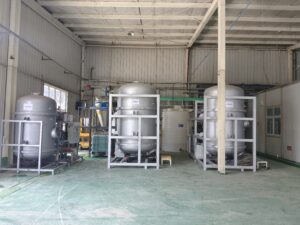
- Vacuum Evaporator
-
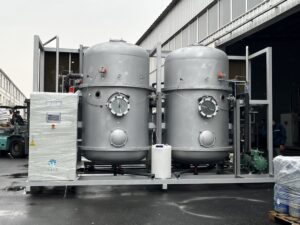
- Vacuum Evaporator
-
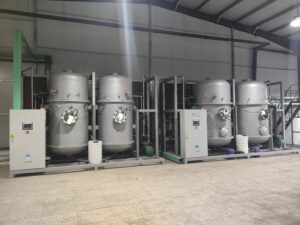
- Vacuum Evaporator
-
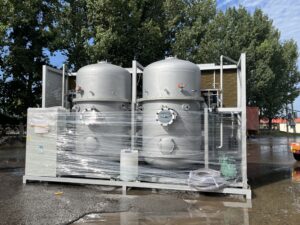
- Vacuum Evaporator