
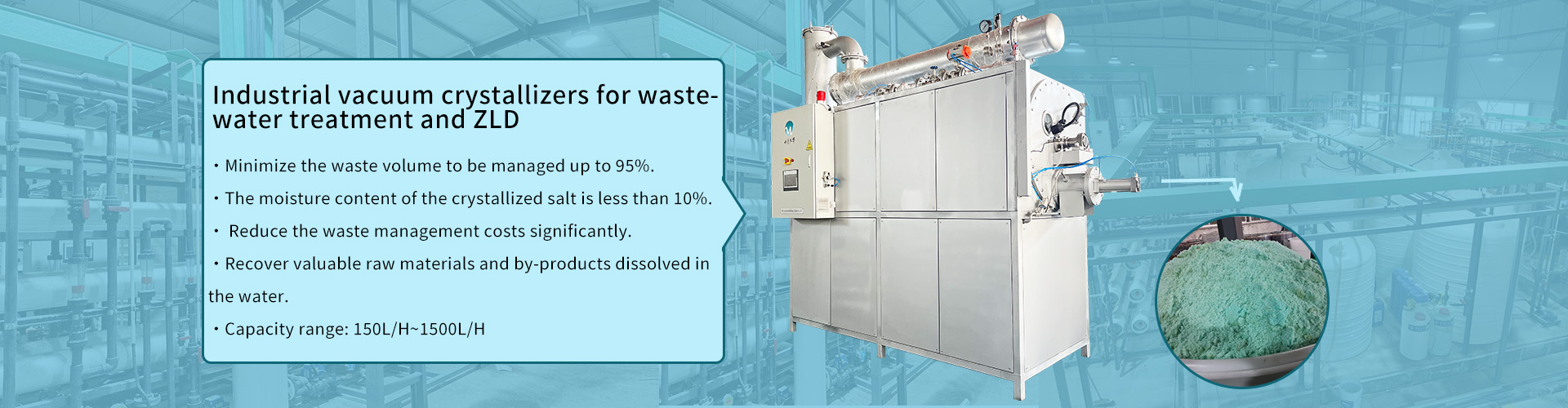
Scraped Vacuum Crystallization
Concentrate Difficult Brines and Manage Crystallizing Streams
Low-temperature vacuum crystallizers with a rotating scraper for high-salinity, viscous, scaling and heat-sensitive materials.
Why Use a Scraped Crystallizer?
As evaporation proceeds, salts may crystallize, viscosity may increase and deposits may form on heat-transfer surfaces. A rotating scraper continuously moves material along the heated wall, helping control buildup and supporting heat transfer and discharge.
Further concentrate feeds approaching salt saturation.
Reduce wall accumulation and maintain movement of concentrated product.
Produce a concentrated slurry, crystals or paste when technically feasible.

Operating Principle
Under vacuum, the feed evaporates at a lower temperature. A heat-pump circuit supplies evaporation heat and condenses the generated vapour. Inside the crystallization chamber, the scraper keeps concentrated material moving and helps remove deposits from the wall. Depending on the salt system and operating endpoint, the discharge may be a slurry, wet crystals or a high-solids concentrate.
Crystallization behaviour must be confirmed experimentally. Salt composition, eutectic behaviour, viscosity, organic content and mixed-ion effects can materially change the result.
Typical Applications
- High-salinity industrial wastewater
- Evaporator concentrate requiring further reduction
- Metal-finishing and plating brines
- Chemical and pharmaceutical process streams
- Resource recovery from salt or catalyst solutions
- Heat-sensitive product concentration
- Mixed-salt wastewater approaching ZLD
- High-viscosity liquids and crystallizing mother liquor
Engineering Features
- Rotating scraper: helps control wall buildup and move concentrated material.
- Low-temperature vacuum operation: suitable for many heat-sensitive feeds.
- Closed heat-pump system: normally operates electrically without external steam.
- Configurable discharge: batch or automatic discharge options according to rheology and solids behaviour.
- Feed-specific materials: selected after reviewing chlorides, fluorides, acidity, alkalinity and temperature.
- Integrated system design: may combine pretreatment, evaporation, crystallization, solid-liquid separation and distillate polishing.
What Determines the Final Result?
Final moisture or solids content cannot be guaranteed from total dissolved solids alone. It depends on salt species, solubility curves, crystal habit, viscosity, entrained mother liquor, organic matter and the chosen separation method. For this reason, GRELLIX recommends representative water analysis and bench testing before defining equipment size and discharge expectations.
Data Needed for Crystallization Evaluation
Full ionic analysis • COD and organic composition • pH • density and viscosity • daily quantity • existing concentration data • required final product • corrosion constraints • representative sample availability.